Why I Left Framer for Astro (and Why I'm Still a Framer Partner)
I still build client sites in Framer, but I rebuilt my own site in Astro for control, performance, and cost. Here's what I gained, what I gave up, and how I built it.
I’ve been building websites for small businesses for over ten years. I’ve also been working as a professional Front-End Web Developer and Web Designer for corporate America for 10 years, ranging from startups to large companies. I’m a Framer Partner. I sell templates on the Framer Marketplace. I still build mostly all client sites in Framer. I would also like to preface this article with the fact that I used to code out vanilla JS by hand, then started teaching myself Vue and React and had to code that out by hand from the docs as well. It was nuts.
While I was rebuilding gabecreativedept.com in Astro, a few people asked if I was breaking up with Framer.
Absolutely not. I just wanted my own site to be fully mine, to own, to cherish.
Here’s why I moved, what I got out of it, and how I built the whole thing.
Why I moved
Three reasons: control, performance, and cost. HUGE.
Control. Framer is great for shipping client work fast, but you build inside the platform’s rules. You gotta stick to what they have built for us to use. Sure, you can build out custom-coded TypeScript components, but it is still limited. Trust me bro, I’ve been here awhile. I was here at Framer when they first launched. No vibe coding, hell, not even AI was around to help you create your own code. You had to already know it, which I did. Ya had to be there.
On my own site I kept hitting the edges. In Astro, every tag, every schema block, every animation is code I wrote (*cough* Claude wrote) and can change. No overrides to fight and no runtime I can’t touch.
One thing I rarely hear get mentioned is the simple fact that you still can’t do REMs or EMs, clamps, or SVH, or anything that is modern when it comes to CSS. Like, what! Come on now.
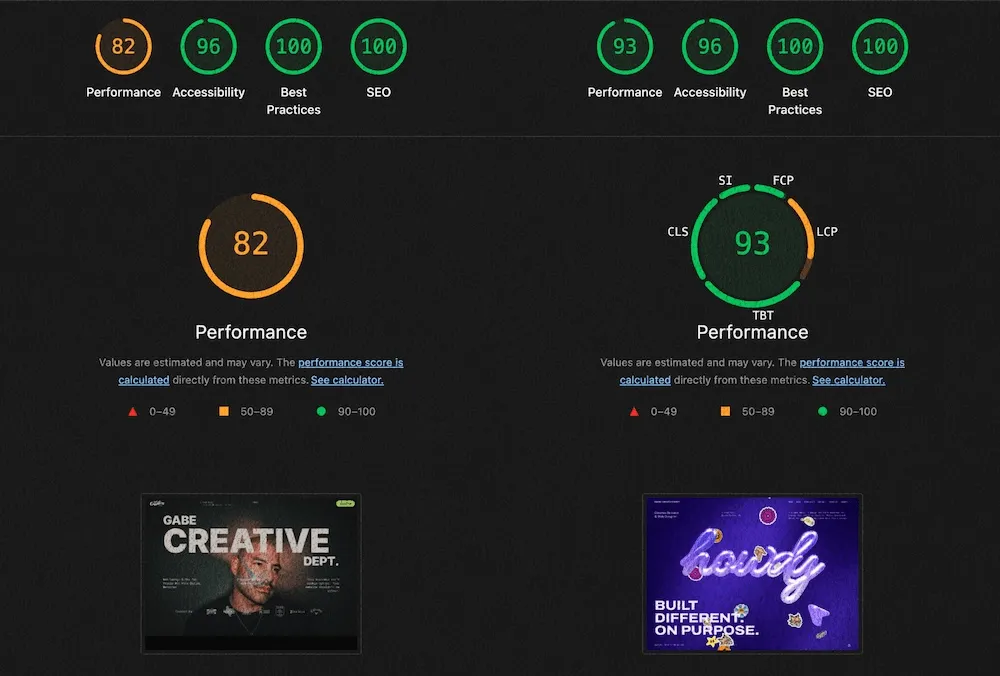
Performance. Astro renders pages to plain HTML and ships zero JavaScript by default. I add JS only where something actually needs it. For a site that’s mostly content, that’s the right starting point. While I still have room to improve, this is a good benchmark test to show the initial increase:
Lighthouse performance score: Framer staging site 82, new Astro site 93.
Cost. Hosting is free. The static build runs on Vercel at no cost! NO brainer compared to the Pro plan I was on. I also wanted a CMS for my projects and templates without paying a monthly plan for it, and Astro’s content collections give me that with plain files in the repo. I update them with Markdown files, which I can feed to Claude to drop in and update the content in seconds! I will most likely add a headless CMS down the road, but right now this is money.
Why now
I finally set up the LLC this month. New entity, new studio brand, new design system, new SOPs. It felt wrong to run all of that on a site I had outgrown, so I decided to build something premium and make it exactly what I wanted it to be.
When you build sites for a living, your own site is the one that has to sell the work. I wanted it to do that without any compromises. I took a huge gamble, because I had barely just updated the design of my site and clients sent me emails weekly about how cool it was, same for people on IG.
The short-term wins
- Speed. Faster loads, less JavaScript, cleaner pages.
- A $0 hosting bill. One less subscription.
- Full control of the head. Titles, meta descriptions, canonicals, Open Graph tags, and structured data are set per page, exactly how I want them.
- No plan limits. I’m not watching page counts or CMS item caps.
- Design freedom. If I can write it, it ships.
The long-term wins
- I own the code. It lives in a Git repo. I can move hosts in an afternoon.
- Costs stay flat. More pages and more traffic don’t change the bill.
- Adding work is adding a file. A new project or template is one content file, validated by a schema, and the pages generate themselves.
- Room to grow. Forms, a template store, integrations, and a blog can all be added without leaving the stack. I use the Web3Forms free tier for my forms. Great for me, since I don’t get extreme amounts of submissions per month. I also still use Etsy for my digital products and Contra for selling templates.
- No lock-in. If I want to change anything about the stack later, I can, and I never have to worry about Framer keeping my site hostage lol.
SEO and AEO
This is the part I care about most, because most business owners find a designer through Google and, more and more, through AI answers. Framer has actually been so good at SEO, especially with how easy it is to use. Old SEO companies still use WordPress and think it’s the king. Ridiculous!
Astro helps in a few ways:
- Clean, server-rendered HTML. Crawlers get the full page without running JavaScript. Many AI crawlers don’t render JS at all, so this matters for answer engines too.
- Structured data on every page. I generate JSON-LD (business, person, services, FAQs, breadcrumbs, articles) from the same data that builds the page, so it never goes stale. I did have a 100% AEO score using that one free Framer tool they had to check it, but I still got more control, son.
- The technical basics, handled. Sitemap, canonicals, redirects, and optimized images, all in my hands.
- Core Web Vitals. Improved all of them except LCP, which I will be fixing soon.
- Search Console. Transferred over clean, still collecting data.
One honest note. Schema and speed are the foundation, not the whole game. In July I tested how AI tools answer “best web design agency in Austin.” My site came up fine when someone searched my name, but not on the broad queries. Those answers pull from places like Clutch, Thumbtack, and Expertise. So the technical side is handled, and now I’m building the citations and reviews on top of it. I tried Thumbtack and hated it, do not recommend. I am also joining my local chamber of commerce and networking more.
How I built it (important)
-
Inspiration. I wish I could take full credit for the awesome overall feel, but I was heavily inspired by a genius that I admire. I started by checking Awwwards for inspo and saw a Site of the Day from the legend @wenhaoqi. I loved it so much. I originally just wanted to see if I could do what he did. I couldn’t! I tried several times in Framer and failed. Just too limited. I took the inspo and ran with it on my own, and the product continues to grow and change weekly!
-
Brand direction. The site is built for business owners who hate boring websites, so the look is a dark background, big cream condensed type, and sticker-style accents, with a voice that talks like a person. These were my already established brand guidelines and the design system that I had in place on Framer.
-
Wireframes and design. The hero and footer are built from the techniques in Wen’s Codrops breakdown, which he published for people to learn from. Full credit to him. The article is literally there for us to use, so I used it! lol. The rest of the site is done off of my already high-converting site, so everything that you see from the hero on is mine. I added my own personal flair and added way more pages. I went in a new and unique direction for the contact page that is my own vision, so take that haters!!

-
Architecture. Astro with content collections for projects, templates, and posts, typed with Zod schemas. You can check out Astro’s structuring in their docs.
-
Components and motion. Built mostly from the article, which did the heavy lifting for crafting the WebGL graphics and cursor zoning, along with the effects and shaders, using my brain as the source for creative direction to give to Claude during the build. It was not easy. Lots of different iterations and bug fixes.
-
The SEO layer. Per-page metadata, JSON-LD, sitemap, and redirects from the old Framer URLs so nothing broke.
-
Deploy. Hosted on Vercel. I simply routed my DNS from Framer to Vercel, easy peasy, added the same analytics code, and added a Vercel tracking code as well for shits and gigs. Then I resubmitted the sitemap in Search Console.
-
Tools and AI. As mentioned, I got to play the role of Creative Director, with Claude Opus 5.5 as the cook. I imported my design system and all my assets to Claude from Framer, so everything was already good to go for my brand.
Total time: I would say about 2 weeks of maybe 2 hours a day as a side project to get it done, but I had one weekend to go all out on it. I kept coming up with different ideas and different ways I wanted to do things, and finally got Claude to be a master of what my overall vision was.
What I gave up
I should be straight about the tradeoffs, but no big deal for my use case.
- No visual canvas. Changes happen in code.
- More setup up front than clicking publish. I used to just click a button, but now I do it the normal dev way, which is having Claude create a pull request with the changes, and then I merge the branches once things look good. This is the professional way of doing things, passed down from my time working for corporate America, so it’s not difficult and I actually enjoy it lol.
- I’m responsible for dependencies and updates.
- Nobody but me can edit it. That’s fine for my own site and a dealbreaker for most clients, but all my client stuff is on Framer.
Why I still use Framer for clients
Most of my clients want to log in, change a headline, and publish. Framer is the best tool I’ve used for that, and it gets a small business online fast. I’ll keep building client sites there, and keep selling templates on the Marketplace.
A custom-coded Astro build makes sense when a client cares about performance, owns a lot of content, wants to avoid platform fees, or needs something a visual builder can’t do cleanly. I would also charge them way more!
The takeaway
Pick the tool that fits the job. Framer for speed and client editing. Astro for control, performance, and ownership. I know a lot of people are switching to Astro, but I wanted to give some perspective from an OG who used to have to code manually, both with a team and solo, using Astro and React back in the day, and from someone who has been a Framer Pro Expert for years now.
If you want a site built like this one or on Framer, I’m taking on new projects at gabecreativedept.com for Q1!
— Gabe Amaya, Gabe Creative Dept.